

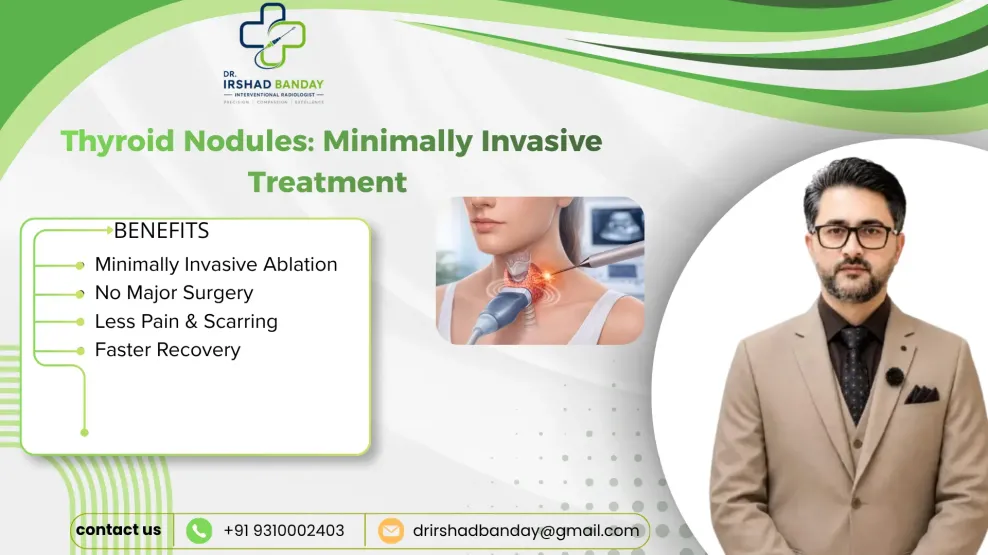
Thyroid nodules are lumps that develop within the thyroid gland, a small, butterfly-shaped organ located at the front of the neck. Many nodules are benign and do not require immediate treatment. However, some may cause visible neck swelling, a sensation of pressure, difficulty swallowing, or other symptoms that need medical assessment.
For patients exploring minimally invasive treatment options for thyroid nodules, the right approach depends on the nodule’s size, ultrasound characteristics, biopsy findings, thyroid hormone levels, and symptoms. Options may include monitoring, selected medication, image-guided biopsy, radiofrequency ablation (RFA), laser ablation, or surgery when indicated.
In Srinagar, patients can seek an assessment from Dr Irshad Banday, Interventional Radiologist (Vascular), at PARAS Hospital, Dalgate Bridge, Munshi Bagh, Srinagar, Jammu and Kashmir 190010, to discuss appropriate diagnostic and image-guided treatment options.
This guide explains the symptoms, causes, diagnosis, minimally invasive procedures, potential benefits, and recovery considerations associated with thyroid nodules.
Symptoms, Causes and Diagnosis of Thyroid Nodules
What are thyroid nodules?
Thyroid Nodules may be solid, fluid-filled, or a combination of both. They can occur as a single lump or as multiple growths within the gland. Some are discovered incidentally during imaging, while others become noticeable because of neck swelling or pressure symptoms.
Most thyroid nodules are non-cancerous. Nevertheless, a proper medical evaluation is important to identify nodules that need further investigation or treatment.
Common symptoms of thyroid nodules
Small nodules often cause no symptoms. Larger nodules or those in particular locations may produce:
- A visible lump or swelling at the front of the neck
- A feeling of tightness or pressure in the throat
- Difficulty swallowing food or liquids
- Discomfort when turning the neck
- Voice changes or persistent hoarseness
- A sensation of something being stuck in the throat
Some nodules also produce excess thyroid hormones. This may lead to palpitations, sweating, tremors, anxiety, or unexplained weight changes.
Seek prompt medical assessment for a growing neck lump or persistent voice changes. Difficulty breathing or rapidly increasing neck swelling requires urgent medical attention.
What causes thyroid nodules?
Several conditions can contribute to nodule formation:
- Benign thyroid growths: Non-cancerous tissue growth may form a distinct lump.
- Thyroid cysts: Fluid can accumulate within the thyroid tissue.
- Multinodular goitre: Several nodules may develop, enlarging the gland.
- Thyroid inflammation: Certain inflammatory conditions can affect thyroid structure.
- Iodine deficiency: In some populations, inadequate iodine intake contributes to thyroid enlargement.
- Thyroid cancer: A minority of nodules are malignant and require appropriate specialist management.
The cause cannot be established from symptoms alone. Clinical examination and diagnostic investigations help determine the next step.
How are thyroid nodules diagnosed?
A structured evaluation helps distinguish nodules that can be monitored from those that may require intervention.
1. Thyroid ultrasound
Ultrasound assesses the nodule’s size, composition, margins, shape, and other features associated with malignancy risk. It also helps guide needle procedures.
2. Thyroid function tests
Blood tests, particularly thyroid-stimulating hormone (TSH), help determine whether the gland is functioning normally. Additional tests may be recommended according to the findings.
3. Fine-needle aspiration cytology (FNAC)
FNAC uses a thin needle to collect cells from a nodule for examination. It can help determine whether the nodule is benign, suspicious, or potentially malignant. Some nodules require repeat sampling or additional testing.
4. Further assessment
Depending on the results, a clinician may recommend additional imaging, repeat biopsy, specialist review, or surgery. The choice depends on the individual risk profile.
When is treatment necessary?
Not every thyroid nodule requires treatment. Small, asymptomatic nodules with reassuring findings may only need periodic monitoring.
Intervention may be considered when a nodule causes pressure symptoms, visible swelling, cosmetic concerns, or excessive hormone production. Suspicious or malignant findings require a different management pathway.
Patients researching Thyroid Nodules should avoid choosing a procedure based on nodule size alone. Diagnosis, symptoms, and individual risk factors are equally important.
Minimally Invasive Thyroid Treatment Options, Benefits and Recovery
What are minimally invasive treatments for thyroid nodules?
Minimally invasive procedures aim to diagnose or treat selected conditions without conventional open surgery. For appropriate thyroid nodules, image-guided techniques can provide alternatives to surgical removal.
The available options differ in their purpose. FNAC is primarily a diagnostic procedure, whereas radiofrequency ablation and laser ablation are treatments that use heat to destroy targeted tissue.
1. Radiofrequency ablation (RFA)
Thyroid radiofrequency ablation uses controlled heat delivered through a thin electrode to treat selected thyroid nodules. Ultrasound guidance helps the specialist position the electrode and monitor the treatment area.
RFA is primarily considered for appropriately evaluated benign nodules that cause pressure symptoms or cosmetic concerns. The treated tissue gradually shrinks over subsequent months.
Potential advantages include:
- No conventional surgical incision
- Preservation of much of the surrounding thyroid tissue
- Use of local anaesthesia in many cases
- Relatively short recovery for suitable patients
- Gradual reduction in nodule volume
RFA is not suitable for every nodule. Suspicious or malignant nodules require appropriate evaluation, and some patients may need surgery or another treatment.
2. Laser ablation
Laser ablation uses energy delivered through a thin optical fibre to generate heat within the targeted nodule. Like RFA, it is generally considered for selected benign thyroid nodules under image guidance.
Its suitability depends on the nodule’s location, size, composition, and relationship to nearby structures. Availability and clinical experience with this technique may vary between treatment centres.
3. Fine-needle aspiration and biopsy
FNAC is a minimally invasive diagnostic procedure rather than a method for shrinking a nodule. It helps assess whether a nodule is benign or whether further investigation is needed.
A biopsy may be recommended before an ablation procedure to establish that the nodule meets the relevant criteria. Some patients require repeat sampling based on ultrasound findings and initial results.
4. Monitoring and medication
Observation may be appropriate when a nodule is benign, small, and not causing symptoms. Follow-up ultrasound helps identify changes that may require reassessment.
Medication is useful for particular thyroid conditions, but it does not reliably shrink every benign nodule. Treatment should address the diagnosed condition rather than be prescribed solely because a nodule is present.
5. When is surgery preferred?
Surgery may be recommended for nodules with suspicious or malignant findings, significant compression, certain hormone-producing nodules, or features that make ablation unsuitable.
The decision should be made after reviewing the available diagnostic evidence and discussing the benefits and limitations of each option.
Benefits of minimally invasive treatment
For appropriately selected patients, minimally invasive procedures may offer several advantages:
- Smaller access point: Thermal ablation generally uses a small skin puncture rather than a conventional surgical incision.
- Thyroid tissue preservation: Ablation targets the nodule without routinely removing the entire gland.
- Reduced recovery burden: Many patients resume routine activities relatively quickly.
- Image-guided precision: Ultrasound helps the clinician monitor the target and nearby structures.
- Individualised treatment: The procedure can be selected according to the nodule’s characteristics and the patient’s needs.
These benefits are not guaranteed for every patient. Possible complications include pain, bleeding, swelling, voice changes, incomplete shrinkage, and the need for repeat treatment. Rare but serious complications can occur.
Recovery after thyroid ablation
Recovery depends on the procedure, nodule characteristics, and the patient’s overall health. After thermal ablation, some patients experience temporary tenderness, bruising, swelling, or discomfort when swallowing.
Patients should follow their treating specialist’s instructions, avoid strenuous activity for the advised period, and attend scheduled follow-up appointments.
Ultrasound monitoring is important because nodule shrinkage occurs gradually. Thyroid function may also be checked when clinically indicated. Increasing neck swelling, new voice changes, severe pain, or breathing difficulty should be assessed promptly.
Thyroid ablation vs surgery
| Feature | Thermal ablation | Thyroid surgery |
| Approach | Image-guided procedure | Surgical removal of part or all of the gland |
| Anaesthesia | Often local | Commonly general |
| Tissue preservation | Targets the nodule | Removes thyroid tissue |
| Recovery | Often shorter | Generally longer |
| Tissue examination | No complete surgical specimen | Removed tissue can undergo histopathology |
| Best suited for | Selected benign nodules | Cancer, suspicious nodules, and other appropriate indications |
Neither option is universally superior. The appropriate choice depends on the diagnosis, nodule location, symptoms, and individual treatment goals.
Image recommendation for this blog

Frequently Asked Questions About Thyroid Nodules
1. Are thyroid nodules dangerous?
Most thyroid nodules are benign, but some require further investigation to exclude cancer. Ultrasound findings, biopsy results, and clinical assessment help determine the appropriate management.
2. Can thyroid nodules be treated without surgery?
Yes. Selected benign nodules can be managed with monitoring or minimally invasive procedures such as RFA or laser ablation. The appropriate option depends on the diagnosis and the patient’s symptoms.
3. Does every thyroid nodule need a biopsy?
No. The decision to perform FNAC depends on ultrasound risk features, size, clinical history, and applicable medical guidelines. Some nodules can be monitored without immediate biopsy.
4. How long does thyroid ablation take to show results?
Nodule shrinkage generally occurs over several months. The extent of reduction varies, and follow-up ultrasound is needed to assess the response.
5. Can thyroid nodules grow again after treatment?
Yes. Some nodules show incomplete shrinkage or regrowth after ablation. Repeat treatment or another approach may be considered following reassessment.
6. Will thyroid ablation affect hormone levels?
Thermal ablation aims to preserve surrounding thyroid tissue, and many patients maintain thyroid function. However, individual outcomes vary, so follow-up testing may be recommended.
7. What is the cost of thyroid nodule treatment in Srinagar?
The cost depends on the required investigations, nodule size and number, procedure selected, hospital charges, and follow-up needs. An individual estimate should be obtained after clinical assessment rather than relying on a general price.
8. Where can I consult a specialist for thyroid nodules in Srinagar?
Patients can seek an assessment from Dr Irshad Banday, Interventional Radiologist (Vascular), at PARAS Hospital, Dalgate Bridge, Munshi Bagh, Srinagar, Jammu and Kashmir 190010. Ask the treating team about the available diagnostic and treatment options appropriate for your condition.
9. Can thyroid nodules disappear on their own?
Some cystic nodules may decrease in size, while solid nodules can remain stable or grow. Regular monitoring helps determine whether intervention is necessary.
10. When should I seek medical attention for a thyroid nodule?
Arrange an evaluation for a new or enlarging neck lump, persistent swallowing difficulty, or voice changes. Seek urgent care if you experience breathing difficulty or rapidly increasing swelling.
Conclusion
Thyroid Nodules can vary significantly in size, composition, symptoms, and clinical risk. While many require only monitoring, others may benefit from minimally invasive treatment or surgery. RFA and laser ablation can offer alternatives to conventional surgery for carefully selected benign nodules, but diagnosis and appropriate patient selection are essential.
For patients in Srinagar, a specialist consultation can help clarify the cause of the nodule, identify the necessary investigations, and determine which treatment options are appropriate. Treatment decisions should be based on clinical findings rather than symptoms or imaging alone.
Book an appointment for thyroid nodule evaluation in Srinagar
Consult Dr Irshad Banday – Interventional Radiologist (Vascular) to discuss your symptoms, diagnostic results, and suitable treatment options.
- Hospital: PARAS Hospital
- Location: Durga Naag, Dalgate Bridge, Munshi Bagh, Srinagar, Jammu and Kashmir 190010
- Contact: +919310002403